

How to Choose a Coffee Grinder for French Press
Table of Contents
- Why French Press Brewing Demands a Different Grinder
- Burr vs. Blade Coffee Grinder: Which One Works for French Press
- Manual Coffee Grinder for French Press: When Hand Grinding Wins
- Coarse Grind for French Press: The Spec That Decides Everything
- How Grind Consistency and Fines Affect Sediment and Flavor
- Best Coffee Grinder for French Press: Matching Budget and Usage
- Maintenance and Long-Term Ownership for French Press Grinders
- Conclusion
- Frequently Asked Questions
Last Updated: October 12, 2026
Why French Press Brewing Demands a Different Grinder
French press brewing is an immersion method, which means coffee grounds sit in hot water for the full brew time instead of being rinsed through a paper filter. At Mocha Me Crazy, we roast every order on demand, so we hear the same question often: why does the same grinder that nails a pour-over taste muddy in a press?
The answer comes down to how water moves through the coffee bed. In a French press, the metal mesh filter catches only larger particles. Anything small slips straight into your cup.
So the grinder has to do two jobs at once:
- Produce a coarse, even grind so water flows at the right pace
- Limit the tiny particles that turn a clean cup gritty
Most cheap grinders fail at the second job. That is the whole game.
Burr vs. Blade Coffee Grinder: Which One Works for French Press
A burr grinder wins for French press every time. A blade grinder chops beans with spinning metal, so you get a mix of powder and boulders in the same scoop. That mix is the enemy of immersion brewing.
Here is the difference in plain terms:
| Feature | Burr Grinder | Blade Grinder |
|---|---|---|
| Grind method | Crushes beans between two surfaces | Spins a blade to chop |
| Particle consistency | Even, repeatable | Uneven mix of sizes |
| Coarse grind control | Adjustable settings | Guesswork |
| Fines and sediment | Low | High |
| Best for French press | Yes | No |
A blade grinder can work in a pinch, but the cup will taste inconsistent from one press to the next. You cannot dial in a grind you cannot control.
How Burr Geometry (Conical and Flat) Changes the Grind
Two burr shapes dominate the market, and they behave differently at coarse settings. Conical burrs use a cone inside a ring.
At coarse settings, the practical differences show up in three places:
- Particle-size spread: Flat burrs usually produce a tighter distribution, which means fewer fines and less sediment in the press. Conical burrs tend to produce a slightly wider spread, which can add body but also more grit.
- Throughput: Flat burrs generally grind faster at coarse settings because the beans clear the gap more quickly. Conical burrs can feel slower, especially on hand grinders.
- Retention: Conical burr grinders often retain less ground coffee in the chute, which matters if you switch beans often.
For French press, either geometry can work well. What matters more is build quality, burr alignment, and how wide the coarse adjustment range goes. A well-aligned conical burr set will beat a poorly aligned flat burr set every time.
Manual Coffee Grinder for French Press: When Hand Grinding Wins
A manual coffee grinder for French press is the best value for most home setups. Hand grinders with steel burrs often match electric models costing far more, because the money goes into the burrs instead of the motor.
Choose manual when:
- You brew one or two presses a day
- You want portability for travel or camping
- You value quiet mornings over speed
The trade-off is effort. Grinding coarse for a full press can take a couple of minutes of steady cranking. If you brew for a crowd every morning, an electric burr grinder will save your wrist.
Coarse Grind for French Press: The Spec That Decides Everything
Coarse grind for French press means particles roughly the size of sea salt or raw sugar. If your grounds look like powder, they are too fine.
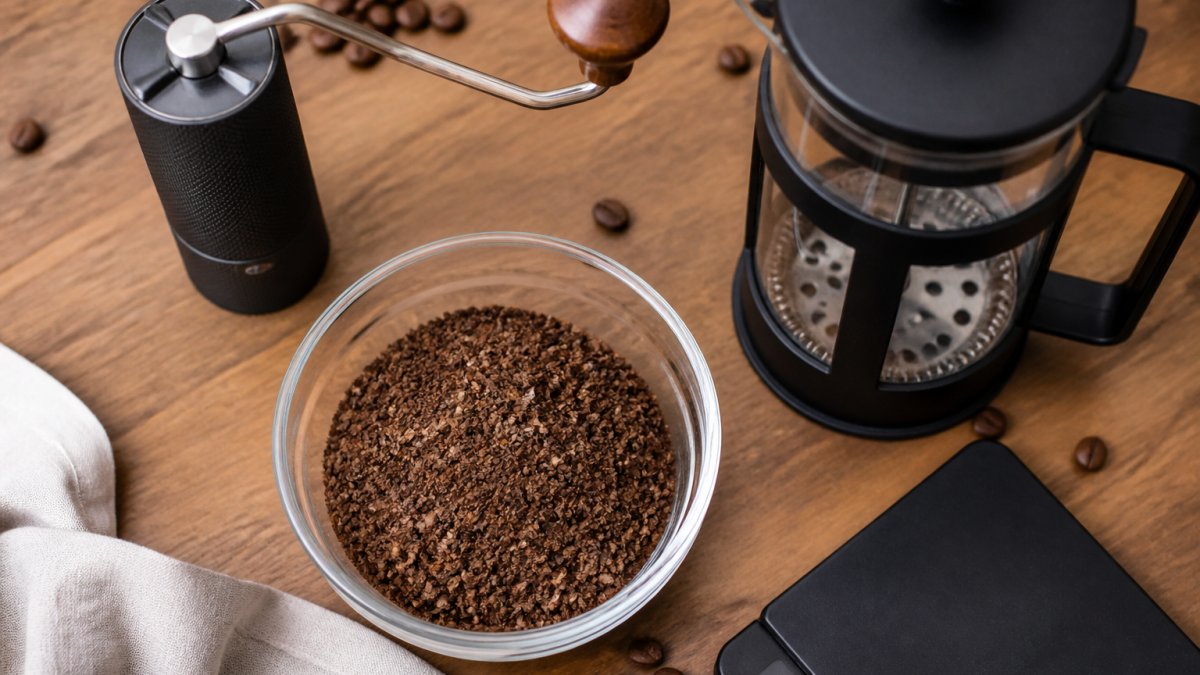
Grind size controls how fast water pulls flavor from the coffee. Too fine, and you get over-extraction: bitterness, grit, and a heavy muddiness. Too coarse, and you get under-extraction: a thin, sour, weak cup.
A Repeatable Method for Dialing In Your Grind Size
Most guides tell you to "grind coarse" and stop there. That is useless advice because every grinder's coarse setting is different. Here is a method you can repeat:
- Start at your grinder's medium-coarse setting
- Brew a full press with your normal ratio and timing
- Taste it, then adjust one notch at a time
- If the cup is bitter or gritty, go coarser
- If the cup is weak or sour, go finer
- Lock in the setting that tastes balanced, and note it down
Keep a small notebook or a note on your phone. Once you find the setting for a given bean, you can return to it every time.
How Grind Consistency and Fines Affect Sediment and Flavor
Grind consistency is the single biggest factor in how much sediment ends up in your cup. Fines are the tiny dust-like particles every grinder produces. A good grinder makes fewer of them.
Sediment is not always bad. Some drinkers like the body it adds. But too much turns the cup muddy and coats your tongue. The fix is not a finer mesh filter, it is a better grind.
What Particle-Size Distribution Actually Means
Every grinder produces a range of particle sizes, not one uniform size. That range is called the particle-size distribution.
The fines are the problem for French press. They pass through the metal mesh filter, stay suspended in the cup, and keep extracting after you plunge.
A common pattern is that two grinders set to the same "coarse" setting produce very different cups because their particle-size distributions differ.
Practical Ways to Reduce Sludge Without Overgeneralizing
Not all coarse settings perform alike, and not all fines come from the same source. Here is how to reduce sediment in order of impact:
- Upgrade the grinder before you upgrade the press. A better burr set reduces fines at the source. No filter change fixes a grinder that produces too much dust.
- Grind coarser than you think you need, then adjust down. Starting coarse and moving finer gives you more control than starting fine and trying to back off.
- Use the right dose. Too much coffee for the water volume means a thicker bed, slower plunge, and more fines forced through the mesh. A common starting ratio is 1:15 coffee to water by weight.
- Plunge slowly and steadily. A fast plunge stirs up the bed and pushes fines through the filter. A slow, even press keeps the bed intact.
- Skim the surface before plunging. The foam and floating particles on top are largely fines. Skimming them off with a spoon removes sediment before it ever reaches your cup.
- Let the press rest after plunging. Waiting 30 to 60 seconds before pouring lets some suspended fines settle to the bottom.
- Consider a secondary filter. A paper or cloth filter placed over the metal mesh catches fines the mesh misses. This changes the body slightly but produces a noticeably cleaner cup.
What to watch for:
- A gritty, sandy texture at the bottom of the cup means too many fines
- A clean, rich body with little grit means your grinder is doing its job
- Inconsistent cups from the same beans point to an uneven grind
If your press always turns out cloudy no matter what you try, the grinder is usually the culprit, not your technique. But before you replace it, run through the steps above. Sometimes a small change in dose or plunge speed fixes a sediment problem that looks like a grinder failure.
Best Coffee Grinder for French Press: Matching Budget and Usage
The best coffee grinder for French press is the one that matches your budget and how often you brew. There is no single winner, because a daily single-cup brewer and a weekend host have different needs.
Here is how to match the grinder to your situation:
| Your Situation | Grinder Type | Why It Fits |
|---|---|---|
| One press a day, tight budget | Manual burr grinder | Best grind quality per dollar |
| Daily brewing, no fuss | Electric burr grinder | Speed and repeatable settings |
| Travel and camping | Compact manual grinder | Portable and no power needed |
| Entertaining a crowd | Electric burr grinder with large capacity | Grinds enough for several presses |
Spend your money on burrs before features. A plain grinder with quality steel burrs beats a fancy one with weak burrs every time.
Grinder Specs That Matter for Coarse Grinding
Ignore the marketing and check these specs instead:
- Burr type and material: Steel burrs last longer than ceramic and hold their edge
- Coarse adjustment range: The grinder must go coarse enough without maxing out
- Particle uniformity: Read reviews that mention consistency, not just speed
Maintenance and Long-Term Ownership for French Press Grinders
Cleaning your grinder is what keeps coarse grinding accurate over the years. Oils from coffee beans build up on the burrs and slowly dull the cut.
A simple upkeep routine:
- Brush out the burrs weekly with a small brush
- Never rinse electric grinders with water
- Run a handful of dry rice or grinder cleaning tablets monthly, if your manual allows it
Manual grinders are easy to keep running for years because there is no motor to fail. Electric grinders last longer when you avoid overheating them with back-to-back grinds.
Pair a well-maintained grinder with fresh beans and the difference shows up in the cup.
Conclusion
Getting a French press to taste great comes down to one hard truth: the grinder matters more than the press.
At Mocha Me Crazy, we built our whole approach around freshness, with beans roasted to order and delivered fast so every cup starts at its peak.
Start with a burr grinder that fits your budget, dial in your grind one notch at a time, and keep the burrs clean. Explore our freshly roasted blends and see how much better your morning press can taste.
Frequently Asked Questions
Should I choose a burr or blade grinder for French press?
A burr grinder is the better choice for French press. Burrs crush coffee beans to a consistent coarse size, while blade grinders chop unevenly and create lots of fine powder. Those fines slip through the French press mesh, leaving gritty sediment and a bitter, muddy cup. If you already own a blade grinder, you can still brew French press with short pulses and a sieve to remove dust, but a burr grinder does the job with far less effort.
How coarse should coffee be ground for a French press?
Aim for coarse grind roughly the texture of sea salt or coarse sand. Individual particles should be visible, not powdery. If your coffee tastes bitter or the plunger is hard to push, grind coarser. If it tastes weak or sour, grind slightly finer. Most burr grinders have a coarse setting you can start from, then adjust in small steps until the brew tastes balanced. A 4-minute steep with a slow plunge is a good baseline for dialing in.
Is a manual grinder good enough for French press coffee?
Yes. A quality manual coffee grinder for French press brewing produces the same consistent coarse grind as a good electric model, often at a lower price. Hand grinders take 30 to 60 seconds for a typical dose, and they are quiet, portable, and easy to store. The trade-off is effort and capacity. If you brew for one or two people, a manual grinder works well. For larger batches or daily multiple cups, an electric burr grinder saves time.
Do I really need an expensive coffee grinder for French press?
You do not need the most expensive model, but grind consistency matters more for French press than for most brew methods because the metal mesh lets fine particles through. A mid-range burr grinder with adjustable settings and conical burrs handles coarse grinding well. Budget hand grinders with steel burrs also work. The key specs are stable burrs, a wide adjustment range, and a coarse setting that stays consistent over time. Price matters less than burr quality and repeatability.