

Subscription Coffee vs Buying in Bulk: 2026 Comparison
Table of Contents
- Quick Comparison: Subscription Coffee vs Buying in Bulk
- Cost Per Cup Coffee Calculator: The Real Math Behind Both Options
- Coffee Subscription with No Commitment: Flexibility Without the Lock-In
- How to Store Coffee Beans for Freshness: Bulk Storage Done Right
- Degassing, Oxidation, and Why Freshness Wins
- Packaging Waste, Sustainability, and Convenience Trade-Offs
- Conclusion: Which Option Fits Your Ritual?
- Frequently Asked Questions
Last Updated: September 19, 2026
Quick Comparison: Subscription Coffee vs Buying in Bulk
The subscription coffee vs buying in bulk debate usually gets framed as a simple price question. That framing is wrong. According to U.S. Department of Agriculture economic research on food retail, how you buy coffee changes far more than your monthly spend: it changes how fresh your beans are, how much waste you generate, and how much counter space you surrender.
At-a-Glance Comparison Table
| Factor | Subscription Coffee | Buying in Bulk |
|---|---|---|
| Per-ounce price | Higher | Lower |
| Freshness at arrival | Roasted to order, days old | Unknown roast date |
| Variety | Rotating origins and blends | One large bag |
| Storage needs | Minimal | Airtight containers, space |
| Waste | Right-sized packaging | Large bags, often wasted |
| Commitment | Flexible, cancel anytime | One-time purchase |
| Best for | Flavor-focused drinkers | High-volume households |
Cost Per Cup Coffee Calculator: The Real Math Behind Both Options
A cost per cup coffee calculator is the fastest way to compare these two models honestly. Divide the bag price by the number of cups it yields, then add the cost of the coffee you throw away because it went stale.
That second number is the one people forget.
Price Per Ounce Breakdown
Bulk coffee almost always wins the raw per-ounce price. A large bag bought on sale looks unbeatable on the shelf tag.
Hidden Costs of Bulk Buying
- Storage containers and vacuum canisters
- Coffee dumped because it lost its flavor
- Counter or pantry space you can't use for anything else
- The upgrade you buy anyway when the bulk bag disappoints
Run the math on a subscription the same way. Mocha Me Crazy prices its 12 Pack Single Serve Coffee Capsules at $22.99, and each capsule is sealed with no oxygen inside so the coffee stays fresh. That seal is doing real work in the cost-per-cup equation.

Coffee Subscription with No Commitment: Flexibility Without the Lock-In
A coffee subscription with no commitment is exactly what it sounds like: recurring deliveries you can pause, skip, or cancel without a penalty. The old model locked you into a contract. The current one treats flexibility as the product.
That shift matters more than most buyers realize.
How Delivery Cadence and Shipping Frequency Work
Mocha Me Crazy roasts every order on demand and ships fast, so what lands on your doorstep is genuinely fresh rather than warehouse-aged.
How to Store Coffee Beans for Freshness: Bulk Storage Done Right
Knowing how to store coffee beans for freshness is the difference between a bulk purchase that pays off and one that quietly wastes money. The enemies are oxygen, light, heat, and moisture, in that order. Most guides stop at "use an airtight container" and move on. That advice is incomplete, because a five-pound bag fails in stages, and each stage needs a different fix.
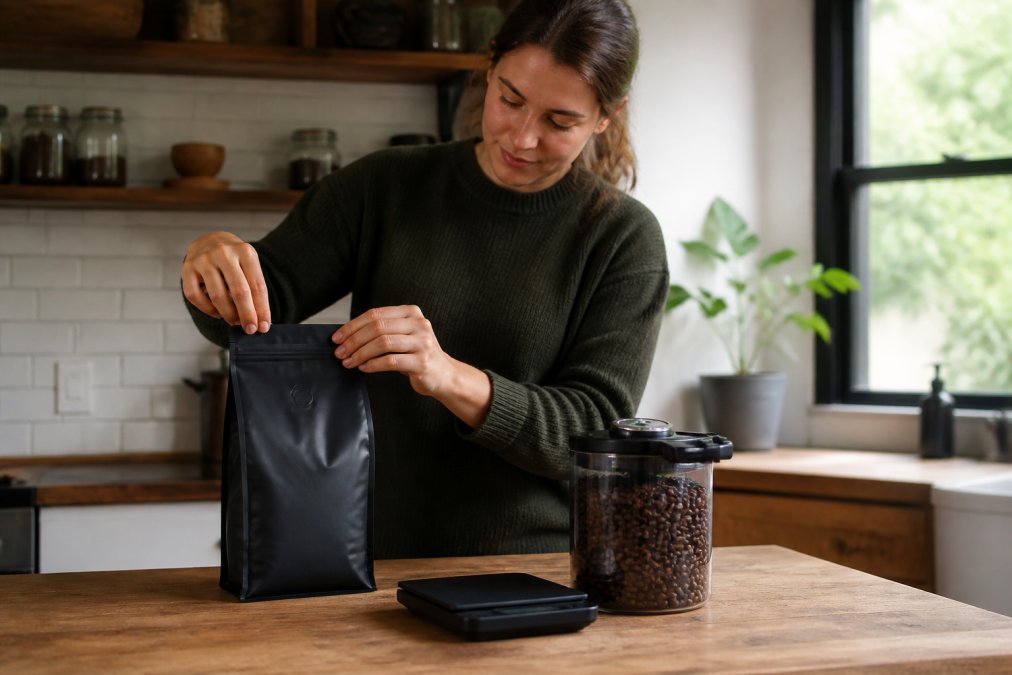
The Two-Container System
The mistake almost everyone makes is storing the whole bulk bag in one container and opening it every morning. Every open exposes the entire supply to fresh oxygen. A better pattern is to split the bag the day it arrives:
- The working container: one to two weeks' worth of beans in a small, opaque, airtight canister you open daily.
- The reserve: the rest, sealed in a way that never gets opened until you refill the working container.
Equipment Requirements for Bulk Storage
- Airtight, opaque containers with one-way degassing valves. The valve lets carbon dioxide escape without letting oxygen in. Clear glass looks nice on the counter but lets light degrade the oils; keep it in a cabinet.
- A kitchen scale. Portion the working container by weight, not by scoop. A digital scale in the $15-$30 range is enough.
- A vacuum sealer (optional but effective). Splitting a five-pound bag into half-pound vacuum-sealed lots is the most reliable way to hold the reserve. Use the pulse or moist setting so you don't crush the beans.
- A cool, dark cabinet away from the stove, oven, and dishwasher. Heat accelerates the same reactions oxygen does.
Freezing: When It Helps and When It Hurts
Freezing is the most misunderstood tool in bulk storage. It works, but only under two conditions:
- Freeze in single-use portions. Once a portion is thawed, it should be brewed, not refrozen. Repeated freeze-thaw cycles pull moisture onto the bean surface.
- Seal before freezing, and don't open until the beans reach room temperature. Opening a cold bag lets condensation form directly on the beans.
Why This Is the Hidden Cost of Bulk
Storing bulk coffee well takes equipment, space, and weekly discipline. A subscription sidesteps all three, because the coffee arrives in the quantity you'll actually use before it declines. If you're not willing to run the two-container system, the bulk price advantage shrinks fast, you're paying for beans you'll brew after they've already faded.
60 Pack Single Serve Coffee Capsules →
Degassing, Oxidation, and Why Freshness Wins
Degassing is the release of carbon dioxide from roasted beans in the days after roasting. Oxidation is the process that follows, where exposure to oxygen steadily flattens the flavors you paid for. Almost no comparison article explains the timeline between these two events, and that timeline is the whole argument.
The Roast-to-Brew Window
Roasted coffee moves through three rough phases:
- Days 1-3 after roast: heavy degassing. Brewed too soon, beans can taste flat or gassy because escaping CO2 disrupts water contact with the grounds.
- Roughly days 4-14: the sweet spot for most beans. Degassing has slowed, oxidation hasn't yet done real damage. This is when a roast shows its best.
- Beyond two to three weeks: oxidation dominates. Aromatics fade, sweetness drops, and the cup turns papery or stale, even in a sealed bag, just more slowly.
These windows are approximate and shift with roast level. Darker roasts degas faster and peak sooner; lighter roasts hold longer. The practical takeaway is that coffee is a perishable product with a best-by measured in weeks, not months.
Why Bulk Bags Fight This Timeline
A large bag is opened many times. Each opening exchanges the headspace air, feeding the oxidation reaction. The beans at the bottom of a five-pound bag may be brewed four to six weeks after the bag was first cracked, well past peak. The per-ounce price you paid at checkout assumed you'd drink every ounce at full quality. You won't.
Why Subscriptions Align With the Chemistry
A roast-to-order subscription ships beans inside the degassing window, so they arrive near their peak rather than past it. Smaller, more frequent deliveries mean each bag is opened fresh instead of being the fourth week of a bulk supply. You're not paying for freshness as a luxury, you're paying to drink coffee inside the window where it actually tastes like what you bought.
Packaging Waste, Sustainability, and Convenience Trade-Offs
Sustainability in coffee comes down to packaging waste and how much you throw away. Bulk bags use less packaging per ounce, which sounds better until you factor in the coffee you dump.
Conclusion: Which Option Fits Your Ritual?
The honest answer depends on volume and priorities. If you brew several cups a day and drink through a large bag fast, bulk buying can work. For everyone else, freshness and flexibility matter more than a lower shelf price.
Frequently Asked Questions
Is a coffee subscription worth it for the average home brewer?
It depends on how much you value freshness. Subscription coffee arrives with a recent roast date, often within days of roasting, which preserves flavor and aroma. If you drink one or two cups a day and want consistent quality without managing bulk inventory, a subscription with no commitment lets you pause or cancel anytime. Bulk buying saves money per ounce, but you may lose flavor before finishing the bag.
Does buying coffee in bulk lead to flavor degradation over time?
Yes. Once roasted, coffee beans begin losing volatile compounds through degassing and oxidation. Whole beans stay fresh for about two to four weeks in an airtight container, while pre-ground coffee declines within days. Bulk bags larger than two pounds often sit open for weeks, so you may end up brewing stale coffee. If you buy in bulk, divide beans into smaller vacuum-sealed portions and freeze what you won't use within two weeks.
How do I calculate the cost-per-cup difference between subscriptions and bulk?
Use a cost per cup coffee calculator. Divide the total price by the number of cups you brew. A 12-ounce bag at $18 yields about 16 cups at 18 grams each, or roughly $1.13 per cup. Bulk beans at $12 per pound yield about 25 cups, or $0.48 per cup. Add shipping, storage equipment, and waste from stale beans to get the true cost. Subscriptions often win on freshness per dollar when you account for discarded coffee.
What is a coffee subscription with no commitment?
It is a delivery service that lets you order coffee without a long-term contract. You choose your delivery cadence, pause shipments, or cancel anytime. Mocha Me Crazy roasts every order on demand and ships directly, so you get fresh beans without being locked into a recurring plan. This model suits home brewers who want variety and flexibility rather than a fixed monthly box.
How does the freshness of subscription coffee compare to bulk store-bought beans?
Subscription coffee is typically roasted to order and shipped within days, so it reaches you near peak flavor. Bulk store-bought beans may sit in warehouses or on shelves for weeks or months before purchase. Check the roast date on the bag: if it is missing or more than a month old, the beans have already lost much of their character. For maximum aroma and flavor, choose roaster-direct coffee with a visible roast date.