

Best Coffee for Remote Work Morning: 7 Picks That Deliver
Table of Contents
- Quick Comparison: Best Coffee for Remote Work Morning
- How to Tell If Coffee Beans Are Fresh
- 1. Breakfast Blend: The Smooth Everyday Starter
- 2. Max Caf Blend: Maximum Caffeine for Deep Focus
- 3. Coffee with Mushrooms Dark Roast: Balanced Energy Without the Crash
- 4. Coffee with Mushrooms Medium Roast: Smooth Focus for Long Work Sessions
- 5. Instant Coffee with Mushroom: Fastest Option for Busy Mornings
- 6. Single Serve Capsules: Convenience Without Compromise
- Best Coffee Brewing Methods for Home Office
- The Bottom Line
- Frequently Asked Questions
Last Updated: September 11, 2026
Quick Comparison: Best Coffee for Remote Work Morning
Finding the best coffee for remote work morning starts with matching a roast to how you actually work. At Mocha Me Crazy, we roast every order on demand, ensuring maximum flavor, aroma, and freshness. Freshness changes flavor, aroma, and how the cup sits with you through a long stretch at the desk.
The seven options below cover the full range: smooth everyday blends, high-caffeine picks for deep focus, mushroom-infused coffees for steadier energy, and instant or capsule formats for mornings when the calendar is already full. If your focus wobbles an hour after your first cup, the roast you chose is usually the reason.
| Coffee | Roast | Best For | Format |
|---|---|---|---|
| Breakfast Blend + | Medium | Everyday smooth start | Whole bean or ground |
| Max Caf Blend | High-caffeine | Deep focus sessions | Whole bean or ground |
| Coffee with Mushrooms Dark Roast | Dark | Balanced energy, no crash | Whole bean or ground |
| Coffee with Mushrooms Medium Roast | Medium | Long work sessions | Whole bean or ground |
| Instant Coffee with Mushroom | Instant | Fastest busy mornings | Powder |
| 12 Pack Single Serve Capsules | Medium | Convenience without compromise | Capsules |
| 60 Pack Single Serve Capsules | Medium | High-volume convenience | Capsules |
How to Tell If Coffee Beans Are Fresh
Coffee beans are fresh when they were roasted recently, ideally within two weeks, and still release a visible bloom when hot water hits them. Freshness is the single biggest factor separating a flat, papery cup from one with real body and aroma, and for remote workers it matters more than for a weekend drinker: the cup you brew at 7 a.m. carries you through a 10 a.m. standup and a noon deadline.

The Roast Date Test
Check the bag for a roast date, not a best-by date. A roast date tells you exactly when the beans left the roaster; best-by dates are often set a year or more out and say nothing useful. If a package only lists a best-by date, treat that as a warning sign.
A useful benchmark: roasted coffee is at its peak roughly 4 to 14 days off the roast for most brew methods. Before day 4, beans are still degassing and can brew unevenly. After about three weeks, the aromatics that make a morning cup worth drinking have largely faded, even if the caffeine is still there (peer-reviewed research).
Visual and Aromatic Cues
Fresh beans look slightly oily or matte depending on roast level, and they smell sweet, nutty, or chocolatey when you open the bag. Stale beans smell like cardboard or nothing at all. A quick bloom test confirms it: pour hot water over a small scoop and watch for bubbles and swelling. Strong bloom means fresh. No bloom means the coffee has been sitting too long.
Storage Mechanics That Actually Preserve Freshness
The four enemies of roasted coffee are oxygen, moisture, heat, and light, in roughly that order of impact. A clear glass jar on the counter next to the kettle exposes beans to all four at once. Better: an opaque, airtight container in a cool cupboard, not on top of the espresso machine and not in the fridge, which cycles through humidity every time the door opens and coffee is hygroscopic, it pulls that moisture in.
Freezing works, with a caveat. Whole beans in a vacuum-sealed or well-pressed freezer bag hold quality for a month or more, provided you let them come to room temperature before grinding (PubMed). Thawing and refreezing the same bag, however, accelerates staling faster than leaving it on the shelf.
Why This Matters More on a Work Morning
A stale cup tastes thinner and more acidic, which pushes people toward more cream, more sugar, and often a second cup to compensate. On a work morning, that second cup lands at 11 a.m. and leaves you jittery going into an afternoon of focused tasks. Buying roasted-to-order, or from a roaster who prints the roast date, removes that variable.
For a deeper look at Specialty Coffee Association guidance on freshness and storage, the trade body outlines how oxygen, moisture, and heat degrade roasted beans over time.
1. Breakfast Blend: The Smooth Everyday Starter
The best coffee for remote work morning is often the one you can drink every day without it wearing on you, and that is what Breakfast Blend delivers. This medium roast blends South American beans for a clean, easy cup that works black or with cream.
Pros: Approachable flavor, consistent day to day, works with any brew method. Cons: Moderate caffeine, so it will not carry a heavy deadline morning on its own.
If you want a little more lift from the same profile, Breakfast Blend + adds Robusta for extra caffeine while keeping the medium roast character intact. It costs $24.99. For most remote workers, this is the sensible default.
2. Max Caf Blend: Maximum Caffeine for Deep Focus
Max Caf Blend is the pick for mornings when the inbox is loud and the deadline is louder: a high-caffeine blend of Tanzania and India Robusta, roasted for a bold, heavy cup that holds up to milk and sugar without losing its edge.

Pros: Noticeably higher caffeine, bold flavor, good for back-to-back calls. Cons: Too intense for light drinkers, and not the cup to reach for after 2 p.m.
Max Caf Blend runs $24.99. Robusta gets a bad reputation from low-grade commodity beans; sourced well and roasted recently, it brings a syrupy body and cocoa bite Arabica alone rarely matches.
3. Coffee with Mushrooms Dark Roast: Balanced Energy Without the Crash
Coffee with Mushrooms Dark Roast pairs specialty-grade coffee with Lion's Mane, Cordyceps, and Reishi mushrooms for steadier energy. The dark roast keeps the flavor deep and roasty, while the mushroom blend rounds off the sharp edges.

Pros: Smooth, grounding cup; dark roast flavor; no jittery spike. Cons: Mushroom flavor is subtle but present, so purists may notice it.
This dark roast costs $24.99.
4. Coffee with Mushrooms Medium Roast: Smooth Focus for Long Work Sessions
Coffee with Mushrooms Medium Roast is the lighter sibling of the dark roast, using the same Lion's Mane, Cordyceps, and Reishi blend over a medium roast base. It suits long stretches at the desk where you want a cup that stays pleasant through the third refill.
Pros: Balanced flavor, easy to drink black, good for marathon sessions. Cons: Milder caffeine than Max Caf, so heavy caffeine users may want two cups.
The medium roast version is also $24.99. A common mistake is treating mushroom coffee as a replacement for a full caffeine dose. It is not. It is a smoother curve, not a bigger one.
5. Instant Coffee with Mushroom: Fastest Option for Busy Mornings
Instant Coffee with Mushroom is the fastest route to a decent cup on a morning that has already gone sideways. Each package provides ab
Pros: Ready in seconds, no equipment, shelf-stable, travel-friendly. Cons: Real mushroom powder leaves slight natural sediment, which some drinkers find unusual.
Instant Coffee with Mushroom is $24.99. That sediment is actually a sign of authenticity. Extracts dissolve clear; real powder does not.
6. Single Serve Capsules: Convenience Without Compromise
Single serve capsules solve the mornings when you want good coffee without grinding, measuring, or cleaning anything. Mocha Me Crazy's Original Roast capsules are sealed with no oxygen inside, so the coffee stays fresh until you brew.
Pros: One-touch brewing, sealed for freshness, consistent cup every time. Cons: Less control over strength than manual brewing, and capsules cost more per cup.
The 12 Pack Single Serve Coffee Capsules run $22.99, while the 60 Pack Single Serve Coffee Capsules come in at $59.99. The improved filter design stops water from shooting straight through the middle, so you get a fuller extraction without a longer brew time.
Best Coffee Brewing Methods for Home Office
The best coffee brewing methods for a home office are pour-over for control, a drip machine for volume, and capsules or instant for speed. Match the method to your morning, not the other way around. On a work morning, the deciding variable is rarely flavor, it is how the method fits between your alarm and your first meeting, and how much cleanup it leaves behind when you are already running late.
Pour-Over: Control, at the Cost of Attention
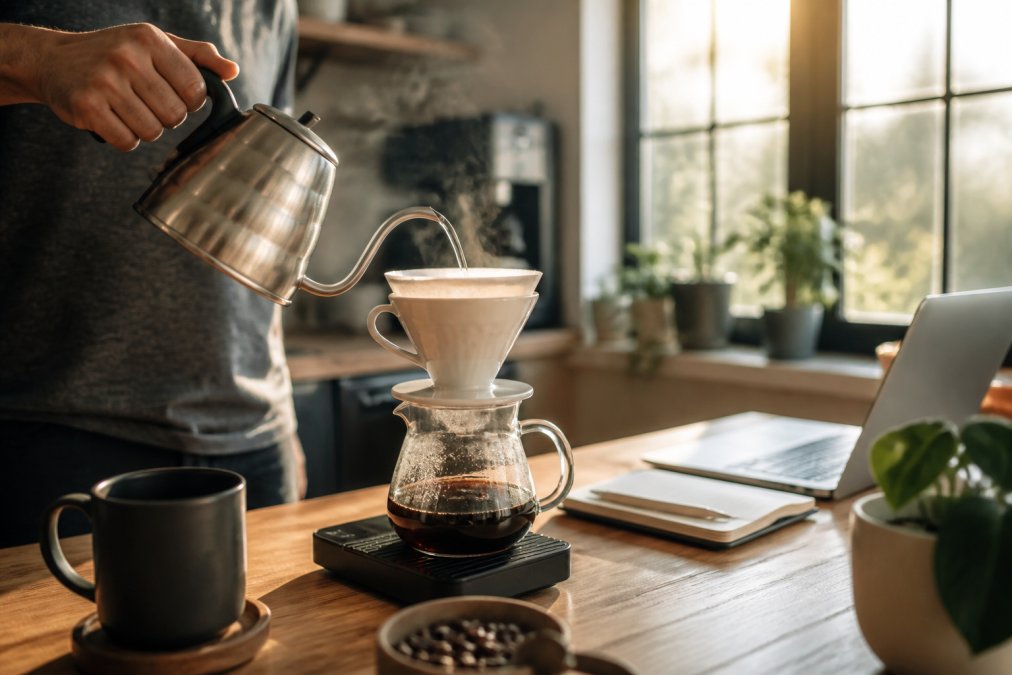
Pour-over suits anyone who wants to dial in flavor and does not mind a four-minute ritual. A standard V60 or flat-bottom dripper with a paper filter gives the clearest read on a bean's character, useful if you rotate through different roasts. The trade-off is attention: you cannot walk away mid-pour to answer a Slack message without risking an uneven extraction. Cleanup is one filter and a rinse, but the brewing itself demands you stand there.
Drip Machine: Volume Without Supervision
A standard drip machine wins when you drink three or more cups and want them ready at once. Load it the night before, set the timer, and the coffee is waiting when you sit down. The catch is holding quality: most drip machines keep a hot plate warm, and coffee on a hot plate for more than about 20 minutes starts to taste scorched. A thermal carafe solves that, the single upgrade that matters most if you brew a full pot and sip through the morning.
Capsules and Instant: The Six-Minute Morning
Capsules and instant exist for mornings when the first meeting starts in six minutes. A capsule machine is ready in under a minute with no grinding, measuring, or filter to rinse. Instant is faster still, hot water, stir, done, and it travels, which matters if your 'home office' is sometimes a kitchen counter, a hotel desk, or a co-working table.
The honest trade-off is cost per cup: capsules and instant almost always run higher per serving than whole bean brewed at home, and you give up some control over strength. What you buy in return is consistency and time, on a packed morning, often worth it.
Matching the Method to Your Calendar
A simple framework: if your first meeting is more than 30 minutes away, pour-over or drip. If it is 10 to 30 minutes away, drip with a thermal carafe or a capsule. If it is under 10 minutes, instant or a capsule you can brew one-handed while opening your laptop. The best method changes with the morning, and keeping two options on hand (one slow, one fast) covers almost every workday start.
Whichever method you choose, grind size matters more than most people expect. Too fine and the water stalls; too coarse and the cup tastes thin. Start medium and adjust one notch at a time: medium for a drip machine, slightly finer for pour-over, noticeably coarser for a French press.
The Bottom Line
The best coffee for remote work morning matches your energy needs to your schedule, and freshness decides how good that cup actually tastes. Whether you want the smooth reliability of a breakfast blend, the punch of a high-caffeine roast, or the speed of instant and capsules, roasted-to-order coffee removes the guesswork.
For a lower-caffeine alternative that still fits the morning ritual, the Instant Coffee pouch covers 30 servings, and the Best Sellers Sample Pack at $26.99 lets you test six blends in 2oz packs before committing to a full bag.
Frequently Asked Questions
What type of coffee is best for staying focused while working?
Medium and dark roasts with higher caffeine content tend to work best for sustained focus. Blends that combine robusta and arabica beans, like Max Caf Blend, deliver a steady energy lift without the sharp spike and crash you get from lighter, lower-caffeine options. Pairing your coffee with a consistent morning routine, such as brewing at the same time each day, helps your body anticipate the caffeine and use it more effectively during deep work blocks.
How does freshly roasted coffee improve morning productivity?
Coffee roasted within days of brewing retains more of its natural oils and aromatic compounds, which translates to a richer flavor and a more satisfying cup. When your coffee actually tastes good, you are more likely to slow down and enjoy it as part of your morning ritual, which supports the mental transition into work mode. Stale beans lose those compounds over time, leaving you with a flat cup that does not deliver the same sensory boost.
How can I tell if my coffee beans are fresh enough for a morning brew?
Check the roast date on the bag. Ideally, you want beans roasted within the last 7 to 14 days. Fresh beans also have a visible sheen from natural oils and release a strong aroma when you open the bag. If the beans look dry and smell faint, they are past their peak. Another test: fresh beans bloom (bubble and expand) when you pour hot water over them. No bloom means no freshness.
Is it better to drink light or dark roast for morning work?
Dark roasts generally have a bolder, less acidic flavor and pair well with milk or cream, making them a comfortable choice for early mornings. Light roasts retain more caffeine by weight and have a brighter, fruitier taste. For remote work, the best choice depends on your stomach sensitivity and flavor preference. If you want maximum caffeine with a smooth finish, a medium-dark blend like Breakfast Blend Plus delivers both without the bitterness of an over-roasted bean.
What are the benefits of ordering coffee roasted on demand for home offices?
Roasted-on-demand coffee arrives at your door within days of roasting, so you skip the weeks or months of warehouse storage that supermarket bags go through. That means better flavor, stronger aroma, and a cup that actually tastes the way the roaster intended. For remote workers who brew at home daily, a subscription or on-demand order keeps your supply fresh without trips to the store. You also get access to blends and single origins you will not find on a grocery shelf.
Your morning coffee should not be the weak link in a productive workday. Mocha Me Crazy roasts every order on demand, sources beans carefully, and delivers fast, so the cup you brew is as fresh as the day it was roasted. Get started with Mocha Me Crazy and turn your first cup into the most reliable part of your morning routine.