

What Temperature Water for Perfect Matcha?
Table of Contents
- Why Water Temperature Makes or Breaks Your Perfect Matcha
- The Ideal Temperature Range for Matcha (Ceremonial vs. Culinary)
- How to Cool Down Boiling Water Without a Thermometer
- Altitude and Boiling Point Adjustments Most Guides Skip
- How to Whisk Matcha Without Clumps
- Is Matcha Tea Good for Weight Loss?
- How to Store Matcha Powder So It Stays Fresh
- Common Mistakes That Ruin Perfect Matcha
- Frequently Asked Questions
Last Updated: October 1, 2026
Why Water Temperature Makes or Breaks Your Perfect Matcha
Water that's too hot scorches matcha and turns it bitter; too cool leaves clumps and a flat, chalky taste. The sweet spot for most matcha is 175°F (80°C), the single biggest difference between a smooth bowl and a disappointing one.

The Science of Catechins and Bitterness
Catechins are the antioxidants that give matcha its grassy edge, and heat pulls them out faster. Past 185°F (85°C), you extract more catechins, astringency, and bitterness in seconds.
What Happens When Water Is Too Hot
Scorching is what boiling water does to matcha: a bitter, astringent cup with a dull, cooked flavor.
Watch for these signs your water was too hot:
- Sharp bitterness that lingers on the back of your tongue
- A flat, hay-like smell instead of fresh grassy notes
- Yellow-green or dull color instead of bright green
- A gritty, drying finish
The Ideal Temperature Range for Matcha (Ceremonial vs. Culinary)
The ideal water temperature for perfect matcha is 175°F (80°C) for ceremonial grade and 165-175°F (74-80°C) for culinary. Ceremonial is delicate and rewards a gentler pour; culinary handles more heat because it's blended into lattes and recipes.
| Grade | Ideal Temp | Why | Best For |
|---|---|---|---|
| Ceremonial | 175°F (80°C) | Protects L-theanine and sweetness | Traditional whisked bowls |
| Culinary | 165-175°F (74-80°C) | Balances flavor and mixability | Lattes, smoothies, baking |
Temperature Differences for Ceremonial and Culinary Grade
Ceremonial grade is made from the youngest leaves and ground finest, meant to be drunk plain, so temperature control matters most. A few degrees too hot and you lose the umami that makes it worth the price.
Why the Grades Behave Differently
The gap isn't marketing, it comes down to leaf age, shading, and milling.
- Leaf age and position. Ceremonial matcha is typically made from the first spring flush, using the youngest buds and top leaves. Those leaves carry more L-theanine and fewer of the tougher, more astringent compounds found in older growth. Culinary grades often blend in later-flush or lower leaves, which are naturally more bitter and can stand up to more heat.
- Shading. Ceremonial-grade tencha is shaded for roughly three to four weeks before harvest. Shading boosts chlorophyll and L-theanine and suppresses catechins, which is exactly why ceremonial powder tastes sweet and savory rather than sharp. Culinary-grade leaves are often shaded less or not at all, so they start with a higher catechin load.
- Milling fineness. Ceremonial matcha is stone-milled to a very fine, almost talc-like powder. Finer particles dissolve and extract faster, so heat hits them harder and faster. Coarser culinary powder extracts more slowly, which gives you a little more margin on temperature.
How Cultivars Change the Target
Most guides treat "matcha" as one ingredient, but the cultivar, the specific tea plant variety, shifts how a powder responds to heat.
- Samidori is a classic ceremonial cultivar known for a rounded, sweet, low-bitterness profile. It's forgiving within the ceremonial range but still punishes anything above roughly 180°F (82°C).
- Okumidori tends to produce a deeper green, slightly more vegetal bowl with a bit more backbone. It can take the top of the ceremonial range, around 175-180°F (80-82°C), without turning harsh.
- Asahi and Gokou are prized for intense umami and sweetness. These are the most heat-sensitive; staying at or just below 175°F (80°C) protects the savory character that makes them desirable.
- Yabukita, the most widely planted cultivar, is often used in culinary and blended grades. It's more tolerant and works across the full 165-175°F (74-80°C) window.
How to Cool Down Boiling Water Without a Thermometer
You don't need a thermometer to hit the right temperature. A few reliable tricks get you close every time, and once you learn the visual and tactile cues, you can do it by eye and hand.
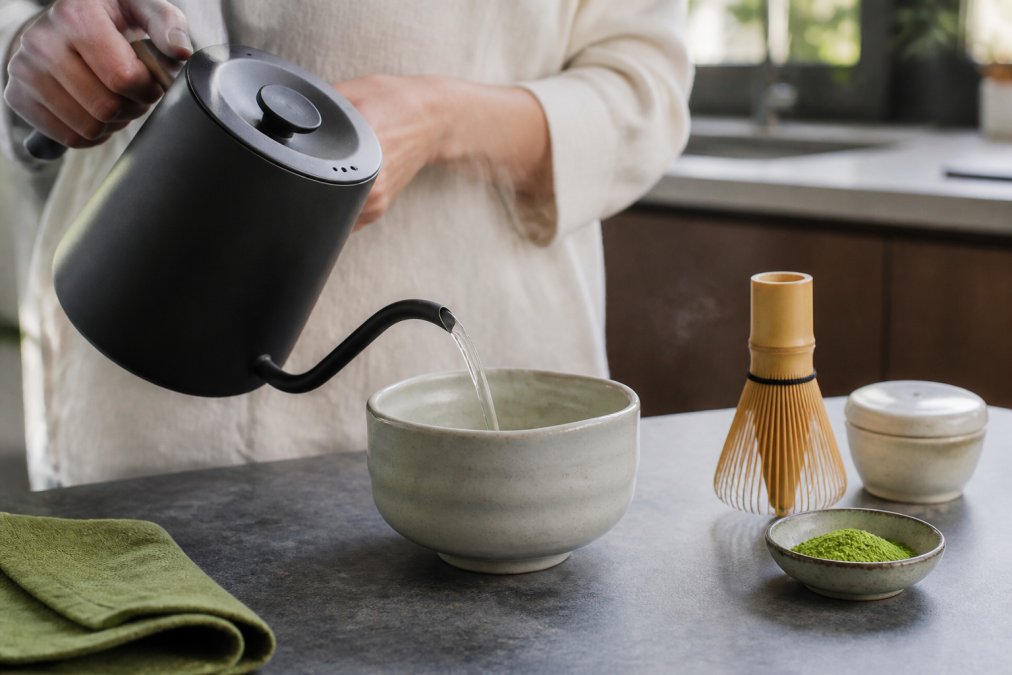
Read the Steam and Bubbles
Before you pour, look at the water. The way it steams and bubbles tells you roughly where it sits.
- Rolling boil (212°F / 100°C): Large, aggressive bubbles breaking the surface, heavy white steam pouring off. Too hot for matcha.
- Simmer (around 195-200°F / 90-93°C): Small bubbles rising steadily from the bottom, moderate steam. Still too hot.
- Just-off-boil (around 185°F / 85°C): Bubbles are sparse and lazy, steam is thin and wispy. Getting closer.
- Target zone (around 175°F / 80°C): Almost no bubbles, faint steam that you can barely see against a dark background. This is where you want to pour.
The Cooling Methods, Ranked by Speed
Here's how the cooling tricks compare.
- Two-cup pour (fastest, most even): Pour boiling water into one cup, then immediately into a second cup. Each transfer exposes the water to cooler air and a cooler vessel wall. Two transfers typically drop the temperature by roughly 15-20°F. A third transfer drops it further. This is the most controllable method because you can stop at any point.
- Cold splash (fastest to fine-tune): Add a small splash of cold filtered water to your hot water. Start with a teaspoon and adjust. One teaspoon of cold water in a small bowl of near-boiling water drops the temperature by only a few degrees, so add gradually and taste-test.
- Wait it out (slowest, least precise): Let boiled water rest 5-8 minutes in an open kettle. It usually lands near 175°F (80°C), but the exact time depends on your kettle's material, the volume of water, and the room temperature. A thin metal kettle loses heat faster than a heavy ceramic one.
- Feel the vessel (tactile check): A warm-but-not-hot bowl against your wrist is a good sign you're in range. If the bowl is too hot to hold comfortably, the water inside is almost certainly too hot.
The Vessel Cooling Technique
The vessel cooling technique means heating your chawan (the bowl) with hot water first, then dumping it out before adding fresh water. A pre-warmed bowl holds temperature steady during whisking.
Here's the sequence:
- Fill your bowl with hot water and let it sit 30 seconds
- Dump the water and dry the bowl
- Add your cooled water, then sift in the matcha
- Whisk without the bowl stealing heat from your brew
Altitude and Boiling Point Adjustments Most Guides Skip
Water boils at a lower temperature as you go up in elevation. At sea level it boils at 212°F (100°C); higher up, your "boiling" water may already be close to target.
How to Whisk Matcha Without Clumps
A smooth bowl comes down to three things: sifted powder, correct water temp, and a proper chasen (bamboo whisk). Clumps usually mean your water was too cool or you skipped sifting.
Follow these steps:
- Sift 1-2 grams of matcha into your bowl
- Add 2-3 oz of water at 175°F (80°C)
- Whisk in a fast "W" or "M" motion, not a circle
- Keep the whisk just off the bowl's bottom
- Whisk 15-20 seconds until a fine froth forms
Is Matcha Tea Good for Weight Loss?
Matcha is often promoted for weight loss because of its catechin content, but it's a small helper, not a magic fix. Many people find it supports a healthy routine alongside balanced eating and movement.
What matcha does offer:
- A gentle caffeine lift without the coffee jitters
- L-theanine for calm focus
- Catechins, which some research links to metabolism support
How to Store Matcha Powder So It Stays Fresh
Matcha is sensitive to light, heat, air, and moisture. Stored right, it keeps its color and sweetness for weeks; stored poorly, it goes stale and bitter fast.
Use these rules:
- Keep it in an airtight container
- Store in a cool, dark place, not above the stove
- Skip the fridge unless it's sealed tight (condensation ruins it)
- Use it within a few weeks of opening for best flavor
Common Mistakes That Ruin Perfect Matcha
Most bad bowls come down to a few repeat offenders. Fix these and your matcha improves immediately.
- Using boiling water: The number one cause of bitterness and astringency
- Skipping the sift: Guarantees clumps and a gritty texture
- Too little powder: Weak, watery matcha with no body
- Slow circular whisking: No froth, no suspension
- Storing it warm: Kills the flavor profile within days
- Reusing old water: Stale water tastes flat, and matcha picks that up
Frequently Asked Questions
Why does water temperature affect the taste of matcha?
Water temperature controls how much of the tea powder's compounds dissolve into your cup. Cooler water in the 160-175°F range draws out amino acids like L-theanine, which give matcha its sweetness and umami. Water that's too hot pulls out catechins and tannins instead, and those are what create astringency and bitterness. That's why the same scoop of powder can taste completely different depending on how hot your water is.
Can I use boiling water for matcha?
You can, but you probably won't enjoy the result. Boiling water at 212°F scorches the tea powder, releasing bitter compounds and killing the natural sweetness. If you have no way to cool it, pour the water between two cups a few times or let it sit for 5-7 minutes. A quick fix is better than ruining a bowl of ceremonial grade matcha. Aim for 160-175°F for the smoothest flavor.
How do I measure water temperature without a thermometer?
Watch the steam instead of the numbers. When water is around 175°F, you'll see a thin, wispy stream rising from the surface with small bubbles forming on the bottom of the pot. At a full rolling boil, the steam is thick and fast. Another trick: pour boiling water into a cool chawan or mug first, then pour it back into your kettle or measuring cup. That single transfer typically drops the temperature 10-15°F.
Does water quality impact the flavor of matcha?
Yes, and it matters more than most people realize. Matcha is a suspension, not an infusion, so you're drinking the entire leaf. Chlorine, heavy minerals, and hard water all come through in the final taste. Filtered water gives you a cleaner base so the grassy notes and umami can come through. If your tap water tastes off on its own, it will taste off in your matcha too.