

7 Best Ways to Automate Coffee Delivery at Home
Table of Contents
- Why Automating Your Coffee Delivery Changes Your Morning
- 1. Set Up a Coffee Subscription With No Commitment
- 2. Use Single-Serve Capsules for Consistent Automated Brewing
- 3. How to Manage Coffee Subscription Frequency Like a Pro
- 4. The Benefits of Fresh Roasted Coffee Delivery vs. Store Bags
- 5. Smart Ordering: Digital Tools That Trigger Your Refills
- 6. Match Your Delivery Schedule to Your Brewing Ritual
- 7. Avoid These Automation Mistakes (And What to Do Instead)
- Frequently Asked Questions
Last Updated: September 6, 2026
The best ways to automate coffee delivery solve one problem: the gap between wanting a perfect cup and having time to source, buy, and store beans. Automating delivery means fresh coffee arrives before you run out, without you thinking about it. At Mocha Me Crazy, we roast every order on demand, making automation worth it because you are not scheduling stale inventory. Below, we show you how to build a hands-off routine that delivers maximum flavor to your door.
Why Automating Your Coffee Delivery Changes Your Morning
Automating delivery removes the most common failure point in home brewing: running out of beans and grabbing a mediocre backup. Eliminating the reorder decision keeps your brewing parameters reliable cup after cup.
1. Set Up a Coffee Subscription With No Commitment
A no-commitment coffee subscription lets you schedule recurring shipments without a contract, ideal for anyone who wants automation without being stuck with beans they do not love.
The key is finding a roaster that roasts to order rather than shipping from warehouse inventory. When beans are roasted after you order, every shipment resets the freshness clock. Look for a service offering flexibility to pause, skip, or cancel anytime, that flexibility makes automation feel safe rather than restrictive.
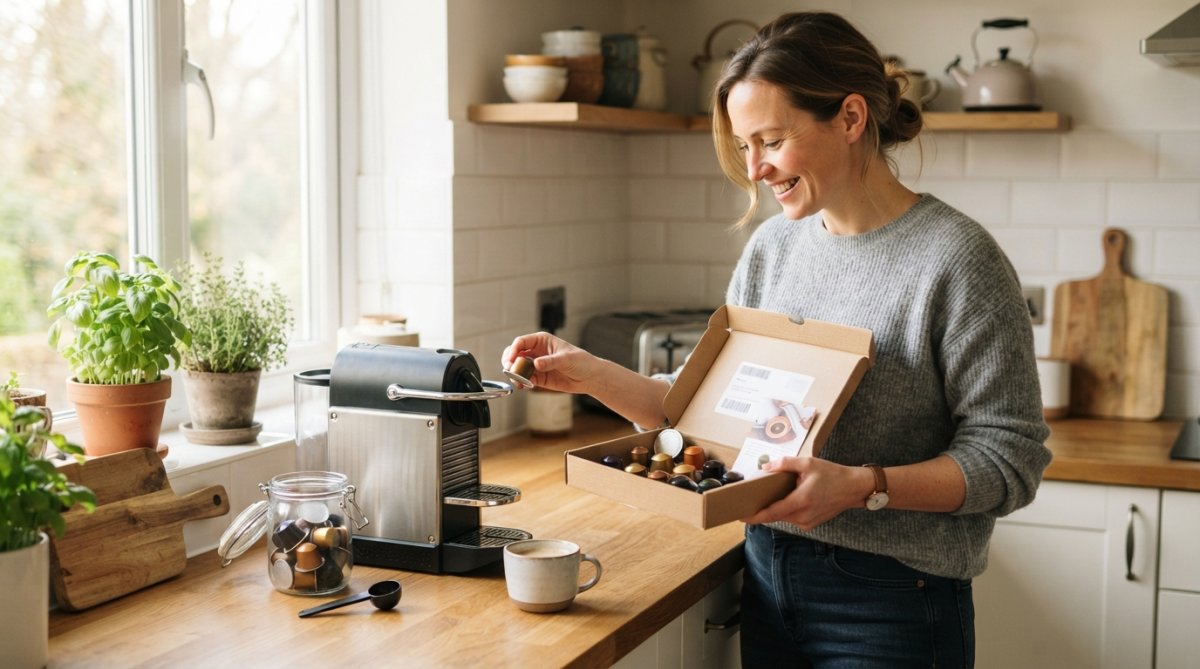
For a seamless start, consider the 60 Pack Single Serve Coffee Capsules from Mocha Me Crazy. At $59.99, this option delivers a signature premium blend in capsules sealed with no oxygen inside, so the coffee stays fresh until the moment you brew. The improved filter design absorbs more grounds for a lively cup without slowing down brew time.

2. Use Single-Serve Capsules for Consistent Automated Brewing
Single-serve capsules are the most reliable way to automate brewing itself, not just delivery. They eliminate grinding, dosing, and tamping variables, keeping extraction consistent even when half asleep.
Capsules also solve the freshness problem of open bags. Individually sealed with no oxygen, the coffee does not degrade like ground coffee in a bag, a significant advantage for those drinking one or two cups daily.
If you are new to this format, the 12 Pack Single Serve Coffee Capsules at $22.99 is a low-risk way to test whether capsule brewing matches your standards. You get the same premium blend and oxygen-free sealing as the larger pack, but with less commitment.

3. How to Manage Coffee Subscription Frequency Like a Pro
Managing subscription frequency is the difference between a system that works and one that creates waste. Time deliveries so you run out of coffee the same day the new shipment arrives.
Start by tracking your actual usage. A typical single-serve routine uses one capsule per cup, so a 12-pack lasts roughly a week and a half for a daily drinker. Once you know your consumption rate, match your delivery cadence to it, starting slightly shorter than you think you need.
| Your Daily Cups | 12-Pack Lifespan | 60-Pack Lifespan | Suggested Delivery Cadence |
|---|---|---|---|
| 1 cup | 12 days | 60 days | Monthly |
| 2 cups | 6 days | 30 days | Every 2 weeks |
| 3 cups | 4 days | 20 days | Every 2-3 weeks |
The pro move is aligning delivery with your brewing ritual. If you are a weekend-heavy brewer, a Friday delivery ensures peak consumption days use the freshest beans.
4. The Benefits of Fresh Roasted Coffee Delivery vs. Store Bags
The benefits of fresh roasted delivery come down to one factor: time since roast. With a grocery store bag, you have no idea when the beans were roasted; they could have sat for months, and the volatile compounds creating flavor and aroma have largely dissipated.
Fresh roasted delivery changes that timeline dramatically. When a roaster like Mocha Me Crazy roasts on demand, beans reach you within days, not months. This freshness window is when coffee is at its peak, producing more complexity, sweetness, and clarity, especially noticeable in single-origin coffees.
For those who want to explore origin flavors, the Mexico Coffee Pods at $23.99 offer tasting notes of lemon, brown sugar, and dark chocolate from the Chiapas region. Similarly, the Peru Coffee Pods deliver salted caramel and citrus profiles, while the Bali Coffee Pods bring dark chocolate and molasses. Each is roasted to order, so origin characteristics arrive intact.

5. Smart Ordering: Digital Tools That Trigger Your Refills
Smart ordering moves beyond recurring shipments into proactive, data-driven replenishment. For home users, this means syncing consumption patterns with your roaster's system. For commercial operators, it means integrating your POS system with brewing hardware and supply chain.
The Home Baseline: Portal Automation
At the most basic level, every serious coffee subscription service offers a customer portal. You set a cadence, and the system generates an order. The differentiator is how much control that portal gives you. Look for these features:
- Skip-ahead logic: The ability to push a scheduled shipment forward by a week without canceling the subscription.
- Bean-swap windows: A cutoff time (e.g., 48 hours before roasting) to swap origins or blends for the upcoming shipment.
- Consumption tracking: Some roasters now offer a simple dashboard that estimates your remaining supply based on your stated daily cup count and the pack size you ordered.
The Commercial Gap: POS-to-Brewer Integration
In a cafe, automating delivery isn't just about beans arriving; it's about the machine knowing what to brew and inventory knowing what to order. The critical integration point is between your POS and automated brewer.
A common pattern is using an API middleware layer (like Zapier or a custom solution) to connect a cloud-based POS (e.g., Square, Toast) to a smart espresso machine (e.g., La Marzocco Linea PB with Swift, or a Mavam). Here is the mechanism:
- Trigger: A customer orders a specific drink via the POS.
- Data Flow: The POS sends a webhook to the middleware.
- Action: The middleware translates that order into a brewing command for the machine, adjusting grind size and dose if the recipe is stored digitally.
- Inventory Update: Simultaneously, the middleware decrements the bean inventory count for that specific hopper.
- Reorder Point: When the inventory count for a specific SKU hits a pre-set threshold (e.g., 2 kg remaining), the middleware automatically generates a purchase order to your roaster's API.
The technical hurdle is that most consumer-grade brewers do not expose an open API, limiting you to the manufacturer's proprietary app. For commercial setups, verify your equipment supports HTTP API calls or at least HTTPS webhooks before buying.
The Reorder Logic That Actually Works
Whether home user or cafe owner, the reorder trigger should be based on par level, not time. A time-based schedule fails with a busy weekend or slow Tuesday. A par-level system works like this:
- Define your minimum stock (e.g., 3 days of beans).
- Define your maximum stock (e.g., 14 days of beans).
- The system orders only when you dip below the minimum, and it orders enough to bring you back to the maximum.
For home users, this logic is rarely available, so you must manually adjust delivery frequency. For commercial users, this logic is the core of a good inventory management system (like Craftable or MarketMan) integrating with your roaster's portal. Without an API for automated purchase orders, you are left checking inventory weekly.
A Practical Example: The Hybrid Approach
Most cafes do not need full machine-to-machine automation on day one. A pragmatic first step is automating the ordering side while keeping brewing manual. Use a shared Google Sheet or inventory app to track daily bean usage, set a formula calculating projected depletion date, and use a scheduled email or task to remind the manager to order when the projected date hits the reorder threshold.
This hybrid approach gives automated trigger reliability without high API integration costs, building the data discipline needed for later full automation. Start with the data layer before investing in the hardware layer.
6. Match Your Delivery Schedule to Your Brewing Ritual
Your brewing ritual should determine your delivery schedule, not the other way around. A pour-over devotee measuring by weight consumes differently than someone pulling two daily espresso shots. Matching the two prevents waste and ensures you have the right coffee for your method.
Consider your week in volume and timing. Many home workers drink more during the workweek, others on weekends. Estimate weekly consumption, then choose a delivery interval keeping a small buffer without a backlog. Aim for a cadence leaving no more than a few days of coffee when the new order arrives.
This is where home versus commercial automation diverges. At home, you optimize for freshness and variety; a cafe optimizes for throughput and labor cost reduction. Understanding your home system is about personal ritual rather than service speed helps you prioritize beverage quality.
7. Avoid These Automation Mistakes (And What to Do Instead)
The most common automation mistakes are not about the coffee, they are about the economics and environmental footprint of the system you build.
Mistake 1: Ignoring the Total Cost of Ownership (TCO)
Most buyers look at the sticker price or subscription fee, forgetting hidden costs: shipping fees, packaging waste disposal, and the convenience premium of single-serve formats.
The Math on Capsules vs. Bulk:
- A typical single-serve capsule costs between $0.50 and $1.00 per cup (peer-reviewed research). At $0.75 per cup, a daily habit costs you $273.75 per year.
- A 12-ounce bag of specialty coffee (roughly 340 grams) costs $18-$25. If you brew 20 grams per cup, that bag yields 17 cups, or about $1.20 per cup. That is more expensive than capsules.
- However, a 5-pound bulk bag (2.27 kg) from a wholesale roaster costs $60-$80. At 20 grams per cup, that yields 113 cups, or about $0.62 per cup. That is cheaper than capsules, but it requires a grinder and a scale.
The Hidden Cost of Waste: If your automated schedule sends you coffee you do not drink, you are paying for disposal. A 12-pack of capsules you throw away costs you $22.99 plus the environmental cost of the plastic and aluminum. The most expensive coffee is the coffee you do not drink.
Mistake 2: Overlooking Energy Consumption of Automated Machines
Automated machines are not energy-neutral. A commercial-grade machine staying on all day to maintain boiler temperature can consume 5-10 kWh per day (energy.gov). At the average U.S. commercial rate of $0.17 per kWh, that is $0.85-$1.70 per day, or $310-$620 per year, just to keep the machine hot.
The Fix: Look for machines with an energy-saving mode or a programmable auto-off feature. Many newer machines, like those with dual boilers, allow you to schedule when the boiler heats up. If your cafe opens at 7 AM, program the machine to start heating at 6:30 AM, not at midnight. This simple change can cut energy costs by 30-40%.
For home users, a pod machine that stays in standby mode draws about 1-2 watts. Over a year, that is negligible (under $2). The bigger energy cost at home is the water heater if you use a plumbed-in machine that maintains temperature. Consider a machine with a tank you fill manually if you are energy-conscious.
Mistake 3: Assuming Automation Reduces Labor Costs Without a Plan
In a commercial setting, automation does not eliminate the barista; it changes their role. With a fully automated brewer, you still need someone to:
- Load beans and water
- Clean the machine daily (descaling, backflushing)
- Handle customer interactions and quality checks
- Troubleshoot jams or errors
The Real ROI Calculation:
Automation saves labor only if it reduces the time per transaction. A traditional espresso shot takes about 30 seconds of active barista time (sca.coffee). A fully automated machine might take 15 seconds. If you serve 200 drinks per day, that saves 50 minutes of labor. At $15 per hour, that is $12.50 per day, or about $4,500 per year in labor savings.
However, the machine itself costs $10,000-$30,000. At $4,500 per year in savings, the payback period is 2.2 to 6.7 years. The faster payback comes from increased throughput, serving more customers per hour during peak times, not from cutting staff. If automation lets you serve 20% more customers during the morning rush without adding a second barista, that revenue increase is where the ROI actually lives.
Mistake 4: Choosing a Roaster Without a Sustainability Program
Automated delivery creates packaging waste. Shipping capsules monthly generates a steady stream of plastic and aluminum. Choose a roaster offering a take-back or recycling program; some use compostable pods (check for BPI certification) or offer a mail-back envelope for used capsules.
Also consider shipping's carbon footprint. A roaster shipping from a single central warehouse has a higher per-package footprint than a regional roaster. For a cafe, consolidating to a single weekly delivery rather than multiple small shipments reduces truck rolls and packaging.
The Bottom Line on Mistakes
The most successful automated systems are not the ones with the most gadgets but those where the operator understands unit economics and the waste stream. Track your actual consumption for two weeks, calculate your true cost per cup including waste and energy, then choose the automation level that pays for itself. Automation solving a measured problem is an investment.
Frequently Asked Questions
How do I set up an automated coffee subscription?
Choose a roaster that offers a coffee subscription with no commitment, like Mocha Me Crazy. Pick your preferred roast or single-origin pods, select a delivery frequency that matches your consumption, and enter your payment details. The roaster roasts your order and ships it automatically. You can pause, skip, or cancel anytime without penalties. Start with a 12-pack to test the quality before committing to a larger 60-pack order.
What are the benefits of fresh roasted coffee delivery?
Fresh roasted coffee delivery means beans are roasted after you order, not weeks before. Coffee starts losing flavor within days of roasting as oxygen degrades the oils. On-demand roasting delivers maximum aroma and a livelier cup. Sealed capsules with no oxygen inside preserve that freshness until you brew. You also get consistent beverage quality without needing to check roast dates on store shelves.
How do I choose the right coffee subscription frequency?
Track how much coffee you drink per week. One 12-pack of capsules typically lasts about 12 days if you drink one cup daily. If you brew two cups a day, a 60-pack covers roughly a month. Set your delivery interval slightly shorter than your actual consumption so you never run out, but not so short that coffee sits unused. Most services let you adjust the schedule anytime if your habits change.
Can I customize my automated coffee delivery schedule?
Yes. Reputable roasters let you manage delivery frequency from your account dashboard. You can switch between weekly, biweekly, or monthly shipments. You can also swap between blends and single-origin options like Mexico, Peru, or Bali pods. If you travel or have extra coffee, skip a delivery or push it back. This flexibility makes automated delivery practical rather than rigid.
What is the difference between a standard subscription and automated delivery?
A standard subscription locks you into a recurring charge with the same product every time. Automated delivery, when done right, gives you control over timing and selection without commitment. You can pause, modify, or cancel easily. The automation handles the ordering and shipping so you never run out of fresh coffee, but you retain the flexibility to adjust when your needs change. That combination keeps your ritual consistent without feeling trapped.