

What Is On-Demand Coffee Roasting? A 2026 Guide
Table of Contents
- What On-Demand Coffee Roasting Actually Means
- How Roast-to-Order Coffee Works From Click to Cup
- On-Demand vs. Traditional Coffee Roasting: Key Differences
- Coffee Degassing After Roasting: Why Timing Matters
- How Long Coffee Beans Stay Fresh (And How to Store Them)
- The Trade-Offs: Cost, Consistency, and Environmental Impact
- Is On-Demand Coffee Roasting Right for You?
- Frequently Asked Questions
Last Updated: October 5, 2026
What On-Demand Coffee Roasting Actually Means
Coffee begins losing its best qualities the moment it leaves the roaster.
The terminology gets muddled, so here is how to separate the three approaches:
- On-demand roasting: Beans are roasted after the order is placed, usually in a dedicated facility, then shipped directly to the customer.
- Roast-to-order coffee: Often used interchangeably with on-demand, though it emphasizes the sequence (order first, roast second) rather than the fulfillment channel.
- In-store roasting: A café roasts on-site, so customers buy beans minutes or hours after the roast. Fresh, but limited to what that shop roasted that day.
The distinction matters because freshness claims are easy to make and hard to verify. A roast-to-order operation can tell you the roast date on every bag.
If you want the deeper chemistry behind why this timing matters, the Specialty Coffee Association's research on coffee freshness is a solid starting point.
How Roast-to-Order Coffee Works From Click to Cup
The workflow behind roast-to-order coffee is simpler than most people expect. An order triggers a roast, the roast triggers a shipment, and the customer receives beans at their peak rather than the end of their shelf life.
Step 1: Bean Selection and Green Coffee Storage
Green coffee beans are the raw, unroasted seeds all roasted coffee comes from. Unlike roasted coffee, they stay stable for months when stored properly, in breathable bags or lined totes kept cool, dry, and away from strong odors, since green coffee absorbs smells.
Sourcing decisions shape everything downstream. A single-origin coffee from one farm or region carries characteristics tied to its soil, altitude, variety, and processing method, washed, natural, honey, and anaerobic are the common categories. Blends combine origins for a consistent profile across crop changes.
Step 2: The Roast Profile and Batch Size
Small-batch roasting means each roast handles a limited volume, often pounds per batch rather than hundreds. Smaller batches give the roaster more control over even heat movement and make it practical to roast a single order without overproducing.
A roast profile is the recorded curve of bean temperature, air temperature, and time across the roast. Roasters track three phases, drying, Maillard reaction (where browning and most flavor development occur), and development through first crack and, for darker roasts, second crack.
Step 3: Cooling, Resting, and Quality Check
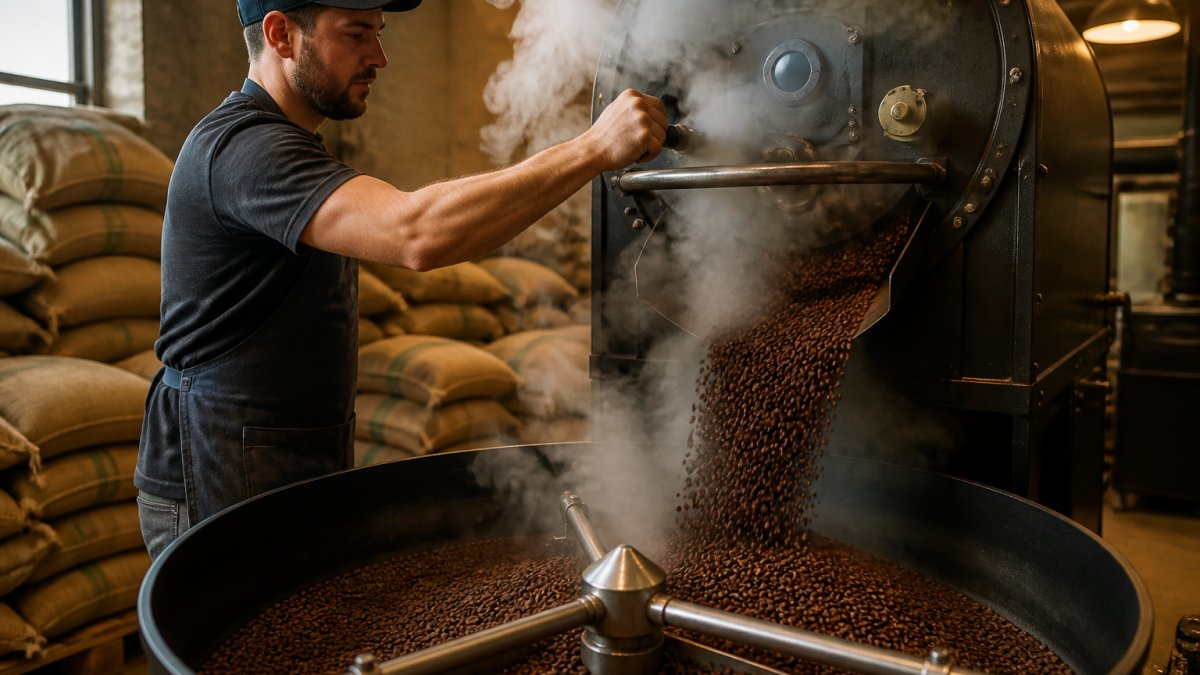
Once the roast ends, beans are dumped into a cooling tray with rotating arms and forced air to stop the roast quickly; left to cool slowly, they keep cooking and drift past the intended profile. Most roasters then cup the batch, a standardized tasting method, to confirm it matches the target.
Step 4: Packaging and the Degassing Valve
Roasted beans release carbon dioxide for days. Sealing them without an escape route swells the bag and can stale the coffee faster. The common fix is a one-way degassing valve: gas exits, oxygen does not enter. The roast date is stamped here, not at the point of sale.
Step 5: Fulfillment and the Turnaround Window
Fast turnaround is the other half of the equation. Once an order is placed, the goal is to roast, cool, package, and ship within a tight window so the customer receives coffee within days of roasting, not weeks. That means batching orders into scheduled roast days rather than roasting one bag at a time, and matching the shipping method to the promise, a two-day roast window paired with a seven-day ground shipment defeats the purpose.
On-Demand vs. Traditional Coffee Roasting: Key Differences
The core difference is when the roast happens relative to the sale: traditional roasting produces to forecast, on-demand roasting produces to order.
| Factor | On-Demand Roasting | Traditional Roasting |
|---|---|---|
| Roast timing | After order placed | Before order exists |
| Batch size | Small, often pounds per batch | Large, production volume driven |
| Inventory | Minimal finished goods | Weeks to months of stock |
| Freshness at delivery | Days after roasting | Variable, often weeks |
| Waste risk | Low, roast to demand | Higher, unsold stock ages |
| Customization | Easier, order-level flexibility | Limited by batch economics |
Traditional roasting is not wrong, it is efficient at scale and how most coffee reaches grocery shelves.
The trade-off is real on both sides: on-demand operations give up some economies of scale for freshness and lower waste. For a drinker who cares about what is in the cup, that trade can be worthwhile.
Coffee Degassing After Roasting: Why Timing Matters
Coffee degassing after roasting is the release of carbon dioxide trapped inside the bean during the roast.
Brew too soon and escaping gas disrupts water contact with the grounds, producing uneven extraction and a flat or sour cup.
This is why roast date matters more than almost any other label detail. A "best by" date tells you when coffee stops being acceptable.
How Long Coffee Beans Stay Fresh (And How to Store Them)
Most coffee beans stay at peak flavor for about two to four weeks after the roast date when stored properly, though the decline is gradual rather than a cliff. Whole beans hold quality longer than pre-ground because less surface area is exposed to air.
Storage rules that actually matter:
- Keep beans in an airtight container, not the original bag if it is not resealable
- Store at room temperature, away from light and heat
- Skip the refrigerator, since moisture and odors migrate into the beans
Grinding right before brewing is the highest-impact freshness habit. Ground coffee begins losing aromatic compounds within minutes, which is why pre-ground tastes flatter even when the beans were fresh.
The Trade-Offs: Cost, Consistency, and Environmental Impact
Most articles about on-demand roasting stop at the benefits. The honest version accounts for what the model gives up and where the costs come from.
Where the Cost Premium Comes From
On-demand roasting costs more per pound than mass-produced coffee, and the drivers are concrete:
- Labor per pound. A small batch ties up a roaster operator for the same time regardless of batch size, so labor cost per finished pound rises as batch size falls.
- Equipment throughput. A small drum roaster produces far less per hour than a large production roaster, so the fixed cost of the machine is spread across fewer pounds.
- Green coffee minimums. Importers and brokers often sell green coffee by the 60-kilogram bag or by the pallet. A roaster buying in small quantities pays more per pound than one buying by the container.
Freshness is what you are paying for. If you do not taste the difference, the premium buys you nothing.
Consistency and Roast Repeatability
Consistency is the harder problem. Traditional roasting produces large, uniform batches, making repeatability easier to guarantee. Small-batch roasting requires tighter process control to hit the same profile twice.
The mechanisms that make repeatability possible are well established in the trade:
- Profile logging. Recording bean temperature, rate of rise, and time at each phase so the next batch can be compared against the last.
- Probe calibration. Thermocouples drift, and an uncalibrated probe means the recorded curve is not the real one.
- Green coffee lot control. A new crop of the same origin will roast differently than last year's, so the profile has to be redeveloped, not copied.
Roast repeatability is the discipline that separates a good on-demand roaster from an inconsistent one. It is also the part customers cannot see.
Environmental Impact Cuts Both Ways
Environmental impact is not a clean win for either model. Roasting to order reduces waste from unsold, aging inventory, a genuine gain, since poured-out stale coffee represents wasted green coffee, fuel, labor, and packaging. But the accounting has to include the other side:
- Energy per pound. Small-batch roasting uses more energy per pound of finished coffee than a large continuous roaster, because the machine is heated and cooled around smaller volumes.
- Shipping footprint. Direct-to-consumer shipping adds packaging and transport miles that a grocery distribution network amortizes across many more units per truck.
- Packaging. Individual bags use more material per pound than bulk packaging, though recyclable and compostable options are increasingly common.
No model wins on every axis. On-demand roasting trades some efficiency for freshness, waste reduction, and the ability to roast to a specific order, a trade worth it for buyers who value the cup over the per-pound price.
Is On-Demand Coffee Roasting Right for You?
On-demand coffee roasting suits drinkers who treat coffee as a daily ritual and notice the difference between a two-week-old bag and a two-day-old one.
A practical way to decide:
- You brew at least a few cups a week and finish a bag within a month
- You have noticed that some bags taste noticeably better than others and want to control for freshness
- You are willing to pay more per pound for beans roasted to order
If most boxes are checked, on-demand roasting will likely improve your daily cup.
the National Coffee Association's consumer data on coffee consumption habits is worth a look if you want to see how your own habits compare to broader trends.
For a concrete starting point, our Whiskey Barrel Aged coffee is a single-origin Guatemalan bean aged 30 days in a bourbon barrel and then roasted to order, priced at $24.99.

Frequently Asked Questions
What does on-demand coffee roasting mean?
On-demand coffee roasting means your beans are roasted only after you place an order, rather than sitting in a warehouse for weeks or months. This approach means the coffee you receive is typically just days old, not months. The result is more flavor, better aroma, and a fresher cup. It differs from traditional roasting, where large batches are roasted, packaged, and distributed through retail channels over a longer timeline.
Is on-demand roasted coffee fresher than store-bought coffee?
Yes, significantly. Store-bought coffee often sits on shelves for weeks or months after roasting, and peak flavor fades within days to a few weeks. On-demand roasting means your beans are roasted close to your order date, so they arrive near peak freshness. You can often see the roast date printed on the bag, which is a key indicator of quality.
How soon after roasting should you brew coffee?
Most coffee tastes best between 4 and 14 days after roasting. Right after roasting, beans release carbon dioxide in a process called degassing, which can interfere with extraction. Letting beans rest for a few days after the roast date allows them to settle. After about two weeks, flavor and aroma begin to fade noticeably, though proper storage can slow that decline.
How long do freshly roasted coffee beans stay fresh?
Freshly roasted coffee beans stay at peak flavor for roughly two to four weeks if stored properly. Keep them in an airtight container away from light, heat, and moisture. Avoid the refrigerator, which introduces moisture. The freezer works for longer storage if you seal beans tightly and defrost before grinding. Buying smaller quantities more often helps you enjoy coffee closer to its roast date.
What is the difference between small-batch and on-demand coffee roasting?
Small-batch roasting refers to the quantity roasted at one time, usually a few pounds per batch. On-demand roasting refers to timing: roasting only after a customer orders. A roaster can be small-batch but still roast ahead of demand. On-demand roasting combines small batches with just-in-time production, so beans are roasted specifically for your order and shipped quickly.
Does coffee need to rest after roasting?
Yes, most coffee benefits from a short rest after roasting. During the first few days, beans release carbon dioxide, which can make brewing inconsistent. A rest period of 3 to 7 days after the roast date often produces a more balanced cup. Some brewing methods, like espresso, may need a slightly longer rest. Check the roast date on your bag and adjust based on taste.
The hardest part of buying better coffee is trusting that freshness claims are real. Mocha Me Crazy roasts every order on demand, sources beans carefully, and delivers fast so the bag in your hand was roasted days ago, not months. No warehouse inventory means nothing sits waiting to be sold, and our simple ordering process makes it easy to keep your ritual stocked. Get started with Mocha Me Crazy and taste what coffee is supposed to taste like when it has not been waiting around.